
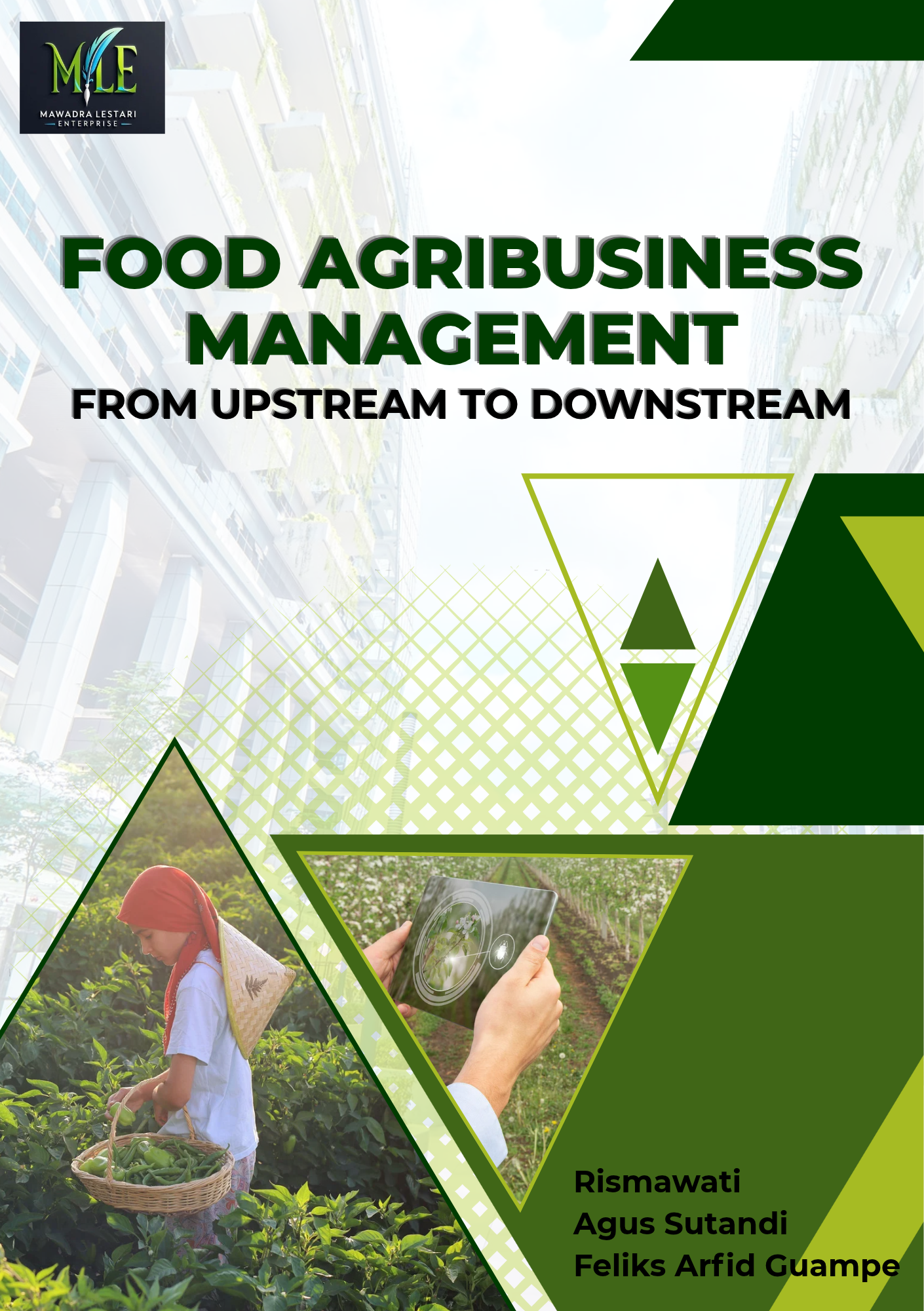
FOOD AGRIBUSINESS MANAGEMENT FROM UPSTREAM TO DOWNSTREAM
Starting: Rp50,000
Collaboratively written by :
Rismawati
Agus Sutandi
Feliks Arfid Guampe
Editor :
Ir. Eddy Jajang Jaya Atmaja, M. M., MBA, P. hD (Cand)
Ir. Eddy Jajang Jaya Atmaja, M. M., MBA, P. hD (Cand)
EISBN :
978-629-7931-67-8
Alasan berbelanja di Mile Media
- Pengarsipan Buku di Perpustakaan Negara Malaysia
- Penulis mendapatkan royalti 40%
- Publish di Playbook
- Buku terindeks Google Scholar
- Free sertifikat HKI dan sertifikat penulis
Description
Reviews (0)
Description
| Select Book | E-Book, Ebook (Indonesian Version), Printed Book, Printed Book (Indonesian Version) |
|---|---|
| SKU | N/A |
| Category | Book & Ebook, Pertanian |
This book discusses food agribusiness management from upstream to downstream. It covers an introduction, food farming production management, post-harvest management and food processing, food agribusiness marketing management, and food agribusiness institutions and policies.
Food is a basic human need that plays a vital role in supporting economic development, improving human resource quality, and ensuring social well-being. Meeting food needs is determined not only by the ability to produce agricultural commodities but also by the effective management of all stages of the food agribusiness system. These stages include the provision of production facilities, farming activities, post-harvest handling, food processing, distribution, and marketing, all the way to consumer acceptance. Therefore, integrated management is necessary to ensure that available resources are utilized effectively, efficiently, and sustainably. In agricultural development, increased production is not always accompanied by increased farmer incomes or improved food quality. Abundant agricultural produce can potentially lose its economic value if not supported by proper post-harvest handling, adequate storage facilities, appropriate processing technology, and an effective marketing system. This situation demonstrates that the success of the food agribusiness is not solely measured by production volume, but also by the ability to maintain quality, extend shelf life, and produce products with added value. Therefore, managing agricultural products from harvest to market is a crucial part of mproving business efficiency and competitiveness in the food agribusiness.
The development of the global food system further emphasizes the importance of comprehensive agribusiness management. The Food and Agriculture Organization (FAO, 2024),in its report, The State of Food and Agriculture 2024, discusses the importance of transforming agrifood systems by considering the
value and impacts of the various activities that make up the food system. This perspective demonstrates that agribusiness success is not solely related to production and financial returns, but also requires attention to efficient resource utilization, environmental impacts, and the distribution of economic and social benefits among all stakeholders. With this approach, agrifood development is expected to provide broader and more sustainable benefits.
Reviews (0)
Leave a Reply
You also like

PUBLIC HEALTH SURVEILLANCE
Starting: Rp65,000 Select options This product has multiple variants. The options may be chosen on the product page
FUNDAMENTAL OF MANAGEMENT
Starting: Rp56,000 Select options This product has multiple variants. The options may be chosen on the product page
ISLAMIC EDUCATION SCIENCE
Starting: Rp56,000 Select options This product has multiple variants. The options may be chosen on the product page
AGRICULTURAL AGRIBUSINESS MANAGEMENT: THEORETICAL AND PRACTICAL APPROACHES
Starting: Rp59,000 Select options This product has multiple variants. The options may be chosen on the product page
INTRODUCTION TO CURRICULUM
Starting: Rp49,000 Select options This product has multiple variants. The options may be chosen on the product page
ENVIRONMENTAL ECONOMICS
Starting: Rp58,000 Select options This product has multiple variants. The options may be chosen on the product page
Pemasaran Industri
Rp300,000 Select options This product has multiple variants. The options may be chosen on the product page
PERTANIAN ORGANIK: KONSEP DAN PRAKTIK LAPANGAN
Rp300,000 Select options This product has multiple variants. The options may be chosen on the product page
TEKNOLOGI BUDIDAYA TANAMAN PANGAN
Rp300,000 Select options This product has multiple variants. The options may be chosen on the product page
INTRODUCTION TO DIGITAL ECONOMY
Starting: Rp58,000 Select options This product has multiple variants. The options may be chosen on the product page
PLANT PEST CONTROL STRATEGIES IN THE MODERN AGRICULTURE ERA
Starting: Rp56,000 Select options This product has multiple variants. The options may be chosen on the product page
Agrotechnology and Sustainable Agricultural Innovation
Starting: Rp59,000 Select options This product has multiple variants. The options may be chosen on the product page
ANTROPOLOGI EKONOMI DAN POLITIK MASYARAKAT TRADISIONAL
Rp300,000 Select options This product has multiple variants. The options may be chosen on the product page
TRANSFORMASI BUDAYA DAN IDENTITAS KOMUNITAS
Rp300,000 Select options This product has multiple variants. The options may be chosen on the product page
PENGINDERAAN JAUH UNTUK PEMANTAUAN HUTAN
Rp300,000 Select options This product has multiple variants. The options may be chosen on the product page
INTERNATIONAL STRATEGIC MANAGEMENT
Starting: Rp65,000 Select options This product has multiple variants. The options may be chosen on the product page
Pengantar Teknologi Pertanian
Rp300,000 Select options This product has multiple variants. The options may be chosen on the product page
10 Juta Perbulan dengan WA Marketing
Original price was: Rp120,000.Rp48,000Current price is: Rp48,000. Add to cart

RESEARCH METHODOLOGY
Starting: Rp45,000 Select options This product has multiple variants. The options may be chosen on the product page


Reviews
There are no reviews yet.